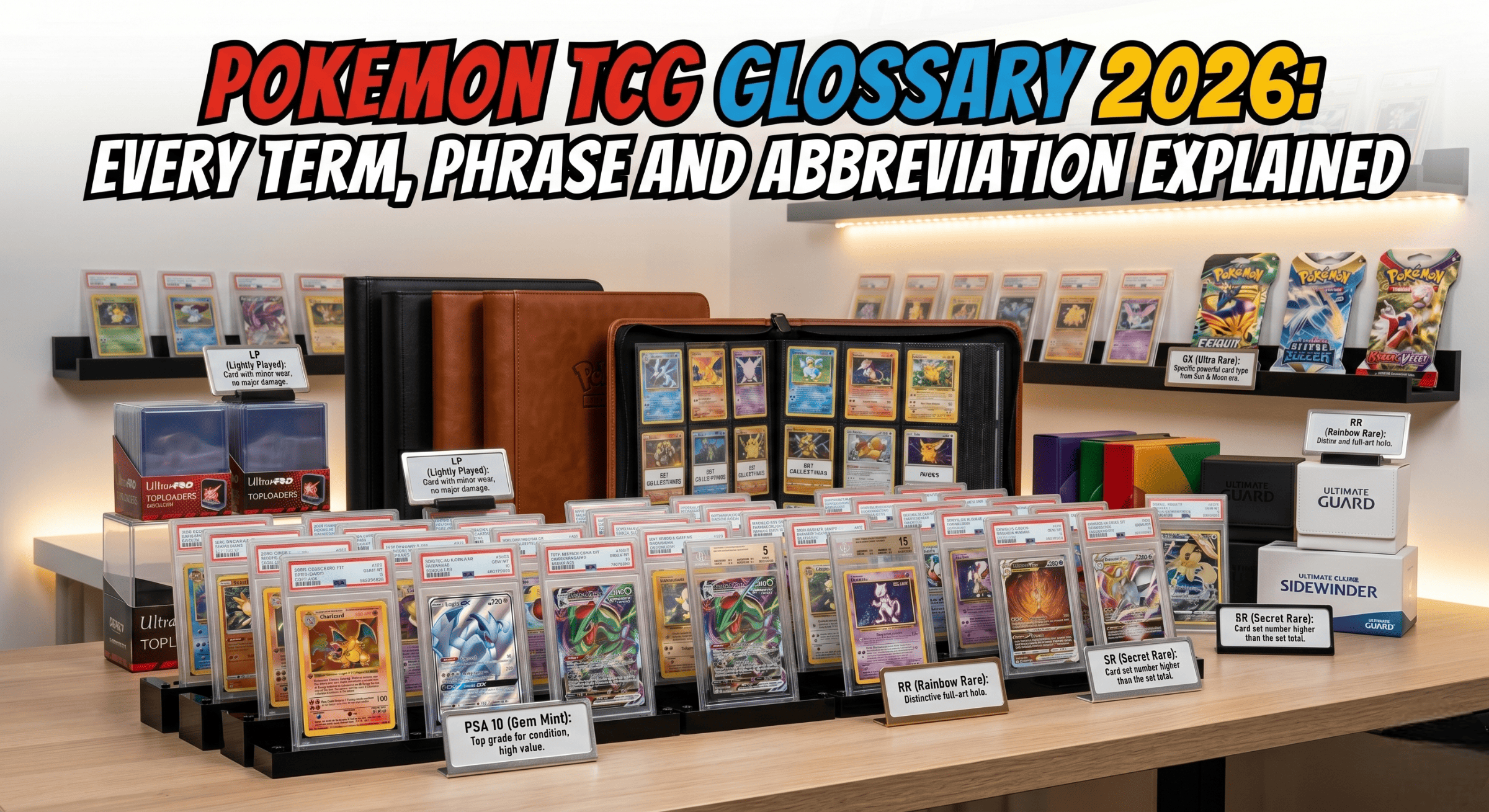
Pokemon TCG Glossary 2026: Every Term, Phrase and Abbreviation Explained
Pokemon TCG Glossary 2026: Every Term, Phrase and Abbreviation Explained
Whether you are brand new to the Pokemon TCG or returning after years away, the hobby has its own language. Collectors talk about SIRs, MARs, MHRs, pull rates, god packs, slabs, and top loaders. Players reference rotating formats, tech cards, and prize trade mechanics. YouTube thumbnails show cards described as "full art," "alt art," and "special art" in ways that seem interchangeable but actually mean different things. And the abbreviations change as new sets introduce new rarity tiers and mechanics.
This glossary covers every term you are likely to encounter as a Pokemon TCG collector or player in 2026. Entries are written in plain English with no assumed knowledge. Bookmark this page and refer back to it whenever a term in a blog, video, or community post leaves you confused.
A
Ability. A special power printed on some Pokemon cards that provides a passive effect or an activated effect that does not count as an attack. Abilities can be triggered once per turn, continuously, or when certain conditions are met. Not all Pokemon have Abilities. In the current Mega Evolution era, Mega Evolution Pokemon ex can have Abilities, unlike their XY era predecessors.
ACE SPEC. A special category of Trainer card introduced in the Scarlet and Violet era that is limited to one copy per deck. ACE SPEC cards are exceptionally powerful and have a distinct gold card back to identify them. Only one ACE SPEC card is permitted in any Standard or Expanded format deck.
Active Pokemon. The Pokemon currently in the battle position, placed in front of the Bench. Each player has one Active Pokemon at a time. Attacks are declared from the Active Pokemon.
Alt Art. Short for Alternate Art. An informal term used by the community to describe cards that feature an alternative artwork composition to the standard version of the same card, typically at a higher rarity tier. In the current era this usually refers to Special Illustration Rares featuring painted scene artwork as the alternative to the standard Double Rare or Ultra Rare versions of the same card.
Archetype. A recognised deck strategy or structure built around a central card or combination of cards. When a new set releases, analysts identify new archetypes introduced by its cards and evaluate how they fit into the existing competitive format.
B
Basic Energy. A standard Energy card that provides one unit of a single Energy type. Basic Energy cards are not restricted in deck quantity and can be retrieved from the discard pile by certain card effects. The eight Basic Energy types are Fire, Water, Grass, Lightning, Psychic, Fighting, Darkness, and Metal.
Basic Pokemon. A Pokemon card that requires no prior evolution to play. Basic Pokemon are placed directly onto the Bench from the hand. In the current Scarlet and Violet and Mega Evolution eras, Pokemon ex are typically Basic Pokemon unless they are part of an evolutionary line, in which case they may be Stage 1 or Stage 2.
Bench. The row of up to five Pokemon cards placed behind the Active Pokemon. Benched Pokemon cannot attack but can use Abilities and can be moved to the Active position when the previous Active Pokemon is knocked out or retreated.
BGS. Beckett Grading Services. One of the three major professional card grading companies alongside PSA and CGC. BGS is known for its subgrade system, which scores centering, corners, edges, and surface individually in addition to the overall numeric grade. The BGS Black Label 10 requires all four subgrades to be perfect tens and is extremely rare.
Binder. A folder with card pocket pages used to store and display a collection. Side loading pages are strongly recommended over top loading pages to prevent cards from falling out. Nine pocket pages are the standard format for Pokemon TCG cards.
Booster Box. A sealed box containing a fixed number of booster packs from a single set, typically 36 packs. Not all Pokemon TCG sets have booster boxes. Special expansions like Ascended Heroes and Prismatic Evolutions do not, which limits their total pack supply and contributes to sealed product appreciation.
Booster Bundle. A retail product containing six booster packs from a single set without additional accessories or promo cards. The Ascended Heroes Booster Bundle is an example available at CardDeckr.
Booster Pack. A sealed pack of Pokemon TCG cards containing a randomised selection of cards from a single set. Modern packs contain ten cards. The contents are determined by the set's pull rate distribution.
Break Evolution. A card type introduced in the XY era that placed horizontally across an existing Pokemon, providing additional HP and attacks while retaining the previous card's text. No longer printed in current sets.
C
Card Saver. A brand of semi rigid card holder used for submitting cards to PSA for grading. Card Saver 1 is the standard size for modern Pokemon TCG cards and is specifically requested by PSA rather than rigid top loaders. The semi rigid construction allows graders to remove cards without handling them directly.
CGC. Certified Guaranty Company. One of the three major professional card grading companies. CGC operates a UK office at cgccards.uk, making it the most accessible grading option for UK collectors. CGC uses a one to ten scale and offers a Pristine 10 tier above standard Gem Mint 10. CGC grades typically sell for slightly less than equivalent PSA grades on the secondary market but the gap has narrowed significantly through 2025 and 2026.
Chase Card. The most sought after and typically most valuable card in a set. Every set has chase cards, usually among the Special Illustration Rares or Hyper Rares, that drive the majority of collector interest and secondary market activity around that set.
Collect and Display. An approach to collecting focused on acquiring and presenting cards for their visual appeal and personal enjoyment rather than competitive play or financial investment. Many collectors pursue specific Pokemon, characters, or artwork styles rather than set completion or competitive viability.
Common. The most frequently appearing card rarity, identified by a filled black circle in the bottom left corner of the card. Commons appear multiple times per pack and have very limited monetary value but are essential for gameplay.
Condition. The physical state of a card, assessed across centering, corners, edges, and surface. Standard condition descriptors used by the community are Mint, Near Mint, Lightly Played, Moderately Played, Heavily Played, and Damaged. Grading companies use numeric scales where ten is perfect and one is severely damaged.
Counter. A marker placed on a card to track damage or other effects. Damage counters typically represent 10 damage each and are placed on Pokemon to track how much damage they have taken.
D
Damage Counter. A small marker placed on a Pokemon card to represent damage taken. Each counter typically represents 10 HP of damage. When the total damage on a Pokemon equals or exceeds its HP, it is knocked out.
Deck. A collection of exactly 60 cards used to play the Pokemon TCG. Standard decks are constructed according to format rules including card quantity limits, Energy card requirements, and format legality restrictions.
Demigod Pack. An informal community term for a booster pack that contains an unusually high number of high rarity cards across three to six slots, without being a full god pack where all slots contain premium cards. Demigod packs are more common than god packs and are still considered exceptional pulls.
Double Rare. A rarity tier identified by two black stars in the bottom left corner of the card. In the current Mega Evolution and Scarlet and Violet eras, Double Rares are Pokemon ex cards. They pull at approximately one in five packs and represent the most common hit tier.
DR. Abbreviation for Double Rare. Used in community discussions and pull rate analyses to refer to Pokemon ex cards at the standard ex rarity tier.
E
Energy. Cards that power Pokemon attacks. Each attack requires a specific number and type of Energy cards attached to the Pokemon. Energy cards come in Basic and Special varieties. Basic Energy can be included in any quantity in a deck. Special Energy cards are limited to four copies per deck and provide additional effects beyond standard Energy provision.
ETB. Elite Trainer Box. A premium retail product containing nine booster packs from a single set alongside accessories including card sleeves, dice, damage counters, a player's guide, and an exclusive foil promo card. The ETB is the most popular product format for serious collectors and is the benchmark product for most new set releases.
EX. In the XY era, Pokemon EX were a powerful category of Pokemon with higher HP and stronger attacks that gave the opponent two Prize cards when knocked out. The term EX referred to a specific era of powerful Pokemon cards. Do not confuse with the current ex designation.
ex. In the current Scarlet and Violet and Mega Evolution eras, Pokemon ex are the primary high power card type. They give the opponent two Prize cards when knocked out, or three Prize cards if they are Mega Evolution Pokemon ex. Written in lower case to distinguish from XY era EX cards.
Expanded Format. A competitive format that includes cards from a wider range of sets than Standard, typically covering the Black and White era onwards. Expanded allows older cards to remain legal alongside current sets and tends to result in faster and more explosive gameplay than Standard.
F
Foil. A reflective or holographic finish applied to part or all of a card. Foil treatment ranges from the simple holo pattern on standard Rare cards to the elaborate textured foil on Special Illustration Rares and the complete gold foil treatment of Mega Hyper Rares. The quality and type of foil finish is a key factor in distinguishing rarity tiers.
Format. The set of rules and card legality restrictions that govern competitive play at a given time. Standard format is the primary competitive format. Expanded format allows older cards. Limited format uses cards from a small pool, typically used in prerelease events.
Full Art. An informal term for cards where the illustration extends across the entire card face without borders. In the current era this encompasses Illustration Rares, Special Illustration Rares, Ultra Rares, and Mega Attack Rares. The term is used loosely in the community and can cause confusion because multiple different rarity tiers feature full art treatment.
G
GX. A card type from the Sun and Moon era featuring Pokemon with a signature GX attack that can only be used once per game across all GX cards in play. GX cards are no longer printed in current sets but remain collected for their artwork and historical significance.
God Box. An informal community term for an Elite Trainer Box or other sealed product that produces an unusually high number of high rarity hits across its pack contents. Unlike god packs, god boxes are not an intentional feature and cannot be reliably identified before opening. The term describes a fortunate variance outcome rather than a specific product category.
God Pack. A booster pack in which every card slot contains a high rarity card rather than the standard mix of commons and uncommons. God packs are an intentional feature of certain special expansion sets including Ascended Heroes and Prismatic Evolutions. In Ascended Heroes a god pack contains three Mega Attack Rares and seven Special Illustration Rares across all ten card slots. God packs appear at approximately one in 2,000 packs.
Gold Star. In the modern rarity system, gold coloured stars in the rarity symbol indicate premium rarity tiers. One gold star indicates an Illustration Rare. Two gold stars indicate a Special Illustration Rare. Three gold stars indicate a Mega Hyper Rare. The colour of the stars, not just the number, is critical for identifying rarity correctly.
Grading. The process of having a card professionally authenticated and assigned a condition grade by a company such as PSA, CGC, or BGS. Graded cards are sealed permanently in a tamper proof plastic slab. Grading protects cards, authenticates them, and can significantly increase their secondary market value, particularly for high grades on popular cards.
H
Holo. Short for holographic. A card with a holographic foil finish. In the modern Pokemon TCG all Rare and higher rarity cards have some form of holographic treatment. The specific pattern and quality of the holo finish varies by rarity tier.
HP. Hit Points. The total amount of damage a Pokemon can take before being knocked out. Modern Pokemon ex have higher HP than standard Pokemon, and Mega Evolution Pokemon ex have among the highest HP totals in the game. HP values in the current era range from around 60 for small Basic Pokemon to 340 for top tier Mega Evolution ex.
Hyper Rare. See Mega Hyper Rare. The term Hyper Rare has been used in both the Scarlet and Violet era and the current Mega Evolution era to describe the gold treatment premium rarity cards that sit above Special Illustration Rares in the rarity hierarchy.
I
IR. Illustration Rare. A rarity tier identified by one gold star in the bottom left corner of the card. Illustration Rares feature full scene painted artwork extending across the entire card face. They pull at approximately one in nine packs in current Mega Evolution sets and typically have secondary market values ranging from a few pounds to around forty pounds depending on the Pokemon depicted and the artwork quality.
Item Card. A type of Trainer card that can be played any number of times per turn without restriction. Item cards provide immediate effects such as drawing cards, searching the deck, or affecting Pokemon. Multiple Item cards can be played in the same turn.
K
Knocked Out. When a Pokemon has taken damage equal to or greater than its HP total, it is knocked out. The player whose Pokemon was knocked out takes it and all cards attached to it and places them in the discard pile. The opponent then takes the appropriate number of Prize cards.
L
Lightly Played. A condition descriptor for cards that show minor wear such as light surface scratches, minor edge whitening, or slight corner softening that is visible under close inspection but does not significantly detract from the card's appearance. Lightly Played cards are eligible for grading but typically receive lower numeric grades than Near Mint or Mint copies.
Limited Format. A competitive format using only cards from a small pool, typically used at prerelease events. Players receive a limited product allocation and build decks from those cards rather than pre constructed 60 card decks.
M
MAR. Mega Attack Rare. A rarity tier introduced in the Ascended Heroes set in January 2026, identified by two stars in pink and green in the bottom left corner. Mega Attack Rares feature full art Mega Evolution Pokemon ex with their signature attack name written in stylised Japanese katakana overlaid on the artwork. They pull at approximately one in 29 packs.
Master Ball Reverse Holo. A premium reverse holo variant introduced in Prismatic Evolutions where the standard Poke Ball holo pattern is replaced with the Master Ball design. Master Ball reverse holos are significantly rarer than standard reverse holos and have their own secondary market values for popular cards.
Master Set. A complete collection of every card variant in a set, including all standard versions, all reverse holo variants, all secret rares, and all promo cards associated with the set. Master sets are a significant collecting challenge. The Ascended Heroes master set runs to 613 cards when all reverse holo variants are included.
Mega Evolution Pokemon ex. In the current 2026 era, Mega Evolution Pokemon ex are a subset of Pokemon ex that follow normal evolution rules, have higher HP and more powerful attacks than standard Pokemon ex, and give the opponent three Prize cards when knocked out rather than the standard two. They are identified by a black and yellow symbol next to their name on the card.
Mega Hyper Rare. The highest standard rarity tier in the current Mega Evolution era, identified by three gold stars in the bottom left corner. Mega Hyper Rares feature a complete gold foil treatment across the entire card face. They pull at approximately one in 200 to 540 packs depending on the set.
MHR. Abbreviation for Mega Hyper Rare. Used in community discussions and pull rate analyses.
Mint. A condition descriptor for cards in essentially perfect condition with no visible flaws. True mint condition is extremely rare in cards that have been opened from packs and handled at all. Professional graders use the term Gem Mint for cards achieving a perfect or near perfect numeric score.
N
Near Mint. A condition descriptor for cards that appear essentially perfect under normal viewing conditions but may have very minor imperfections visible under close inspection or harsh lighting. Near Mint is the target condition for most collectors buying singles and is the standard benchmark for raw card value guides.
P
Pack Weighing. The practice of weighing sealed booster packs using a precision digital scale to attempt to identify packs containing heavier holographic cards. Pack weighing is considered unreliable by the community due to manufacturing weight variations across standard packs. It is also considered unethical in retail settings where weighed packs are returned to shelves after removing heavier ones. Most reputable retailers take steps to prevent pack weighing in store.
Penny Sleeve. A thin soft plastic sleeve that goes directly over a card as the first layer of protection. Every card worth protecting should be placed in a penny sleeve immediately after leaving the pack. Penny sleeves protect against surface scratches but provide no structural protection against bending.
Prize Cards. Six cards placed face down at the start of a game, drawn one at a time when the opponent's Pokemon are knocked out. Standard knocked out Pokemon award one Prize card to the opponent. Pokemon ex award two Prize cards. Mega Evolution Pokemon ex award three Prize cards. The first player to take all six Prize cards wins the game.
Promo Card. A card distributed outside of standard booster packs, typically through retail product bundles, event attendance, or special distribution programs. Promo cards are marked with a black star containing the word PROMO. They are not found in standard booster packs and their value is determined by their availability and demand rather than a standard rarity system.
PSA. Professional Sports Authenticator. The largest and most established professional card grading company, founded in 1991. PSA grades hold approximately 70 percent of the graded Pokemon card market. PSA 10 Gem Mint is the most recognised and typically highest value grade in the hobby. UK collectors can submit through authorised middlemen such as Subcentre.
Pull Rate. The average frequency at which a specific rarity tier appears across a large number of pack openings. Pull rates are not published officially by The Pokemon Company and are determined through community data aggregation from thousands of documented pack openings. Individual results will vary significantly from the average.
R
Rare. A rarity tier identified by a single black star in the bottom left corner of the card. In the current era all Rare cards have a holographic finish. Standard Rares pull at approximately one per pack and have modest secondary market value.
Regulation Mark. A letter printed on modern Pokemon TCG cards that indicates which Standard format rotation the card belongs to. When a new rotation occurs, cards with older regulation marks rotate out of Standard format legality. The regulation mark is found in the lower left area of the card.
Reprint. A card from a previous set that is reprinted in a new set, either with identical artwork or a new illustration. Reprints increase the supply of that card and typically reduce its secondary market value as a result. Reprints can also introduce classic or beloved card designs to a new generation of collectors, as with the crystal Lugia reprint in the 30th Anniversary Celebration set.
Retreat Cost. The number of Energy cards a player must discard to move their Active Pokemon to the Bench and bring up a new one. High retreat costs make a Pokemon less flexible to play around. Some Pokemon have a zero retreat cost, allowing free movement without discarding Energy.
Reverse Holo. A card variant where the holographic foil treatment appears across the entire card background rather than just the artwork window. Most non ex cards in a set have a reverse holo variant alongside the standard version. Reverse holos are common but in certain sets like Prismatic Evolutions and Ascended Heroes they come in multiple distinct variants with their own rarity and value.
Rotation. The annual update to the Standard format that removes cards with older regulation marks from legal play. Rotation keeps the competitive format fresh by preventing older, potentially dominant cards from remaining legal indefinitely. The April 2026 rotation removed all cards with the G regulation mark from Standard format.
S
Secret Rare. A card whose number exceeds the official numbered card total of the set. If a set has 217 main set cards but cards numbered up to 295, the cards numbered 218 through 295 are secret rares. Special Illustration Rares, Mega Attack Rares, Mega Hyper Rares, and other premium cards in the current era are typically secret rares.
Set. A named collection of Pokemon TCG cards released together as an expansion. Each set has its own card list, rarity distribution, and themed artwork. Sets release approximately every three to four months in the current era.
Singles. Individual cards bought or sold separately rather than as part of sealed product. Buying singles is typically more cost efficient than opening packs to chase specific cards, particularly for high rarity chase cards with long average pull odds.
SIR. Special Illustration Rare. A premium rarity tier identified by two gold stars in the bottom left corner of the card. SIRs feature full painted scene artwork with textured foil finishes. They pull at approximately one in 55 to 100 packs depending on the set and are typically the highest value non Hyper Rare cards in any set. Do not confuse with Double Rares, which are identified by two black stars. The colour of the stars is the critical distinction.
Slab. An informal term for the tamper proof plastic case used by professional grading companies like PSA, CGC, and BGS to seal graded cards. Slabs permanently encase the card with a label confirming the card identity, grade, and a certification number for verification.
Special Energy. An Energy card that provides additional effects beyond standard Energy provision. Special Energy cards are limited to four copies per deck and are restricted to certain formats. They are more powerful than Basic Energy but are subject to removal by card effects that specifically target Special Energy.
Special Expansion. A Pokemon TCG set released outside the standard main set schedule, typically with a premium card composition, no booster box format, and limited product types. Special expansions like Ascended Heroes and Prismatic Evolutions have higher chase card density than main sets and their sealed products tend to appreciate more rapidly after retail availability ends.
Spirit Link. A Pokemon Tool card from the XY era that, when attached to a Pokemon EX before it Mega Evolved, prevented the player's turn from ending upon Mega Evolution. Spirit Links were essential to competitive Mega Evolution decks in the 2014 to 2016 XY era. They are not required in the current 2026 Mega Evolution era, where the turn ending rule no longer applies.
Stadium. A type of Trainer card that remains in play until replaced by another Stadium card. Stadiums affect both players and create ongoing conditions that shape gameplay strategy. Forest of Vitality from Perfect Order is an example of a Stadium card relevant in the current format.
Standard Format. The primary competitive format for the Pokemon TCG, covering cards from recent sets as defined by the current rotation. Standard is the format used at most official tournaments and regional championships. Cards rotate out of Standard when new regulation marks are introduced and older marks are removed from legal play.
Supporter. A type of Trainer card limited to one use per turn. Supporters are among the most powerful individual cards in any format, providing significant draw power, search capability, or disruptive effects. Because only one Supporter can be played per turn, the choice of which Supporter to play each turn is one of the most strategically significant decisions in competitive play.
T
Tech Card. A card included in a deck specifically to counter a particular threat or address a specific weakness rather than as a core part of the deck strategy. Running one or two copies of a tech card is common in competitive deck construction to improve matchups against popular archetypes.
Tool Card. A Pokemon Tool is a type of Trainer card that attaches to a Pokemon and provides an ongoing effect for as long as it remains attached. Each Pokemon can only have one Tool card attached at a time. Spirit Links from the XY era were Tool cards. Removing an opponent's Tool card is a significant disruptive action in competitive play.
Top Loader. A rigid plastic card case that slides over a penny sleeved card to provide structural protection against bending and edge damage. Top loaders are the standard individual protection solution for cards worth over approximately ten pounds. Card Saver 1 semi rigid holders are the preferred format for PSA grading submission.
Trainer Card. One of the three main card categories in the Pokemon TCG alongside Pokemon and Energy. Trainer cards include Items, Supporters, Stadiums, and Pokemon Tools. They provide the strategic toolkit that enables deck strategies to function and are the primary way players interact with the game beyond attacking.
U
Uncommon. A rarity tier identified by a filled black diamond in the bottom left corner of the card. Uncommons appear multiple times per pack, are more frequent than Rares but less frequent than Commons, and have limited monetary value but are important for gameplay.
Ultra Rare. A rarity tier identified by two silver stars in the bottom left corner of the card. Ultra Rares are full art Pokemon ex cards with borderless artwork and textured foil finishes. They pull at approximately one in 20 packs and represent a genuine mid tier collector hit. Do not confuse with Illustration Rares, which have one gold star, or Special Illustration Rares, which have two gold stars.
UR. Abbreviation for Ultra Rare. Used in community discussions to refer to full art ex cards at the standard Ultra Rare rarity tier, identified by two silver stars.
V
VMAX. A card type from the Sword and Shield era representing Dynamax and Gigantamax Pokemon with extremely high HP and powerful attacks. VMAX cards are no longer printed in current sets but remain collected for their artwork and competitive relevance in Expanded format.
VSTAR. A card type from the Sword and Shield era featuring a signature VSTAR Power that could only be used once per game across all VSTAR cards. VSTAR cards are no longer printed in current sets.
W
Weakness. A type matchup that causes a Pokemon to take additional damage from attacks of a specific type. In the current era, Weakness typically adds 30 extra damage to an attack rather than doubling it as in earlier eras. Building around Weakness matchups is an important element of competitive deck construction.
Where to Buy Pokemon TCG Products in the UK
CardDeckr is a UK based, registered Pokemon TCG retailer stocking factory sealed, authentic product from the current Mega Evolution era including Ascended Heroes, Perfect Order, Chaos Rising, and more. Visit carddeckr.com to browse current stock, sign up for a free account to receive stock notifications, and get 5% off every order. Pokémon and all related names are trademarks of Nintendo, Creatures Inc., GAME FREAK inc., and The Pokémon Company. CardDeckr is not affiliated with The Pokémon Company International.